



A comprehensive guide for entrepreneurs, investors, and business owners looking to build globally efficient, legally compliant financial structures.
Disclaimer: This article is for informational and educational purposes only. It does not constitute legal, tax, or financial advice. Always consult a qualified legal and tax professional before making any structuring decisions.
Introduction: The Reputation Problem Nobody Talks About
When most people hear “offshore structuring,” they picture shadowy bank accounts, leaked documents, and billionaires hiding money from governments. The reality could not be more different.
Offshore structuring is simply the legal process of organizing a business, its assets, or finances across multiple jurisdictions — typically in countries that offer favorable tax laws, strong legal systems, or business-friendly regulatory environments. It is used every day by multinational corporations, venture capital funds, family offices, digital entrepreneurs, and high-net-worth individuals — all operating entirely within the law.
The era of pure secrecy is over. Today’s offshore structuring is about one thing: building a smarter, more efficient, and fully compliant global business framework.
This post will walk you through everything — the basics, the vehicles, the benefits, the regulatory landscape, and the best practices that separate smart structuring from costly mistakes.
Part 1: The Basics — Key Concepts You Must Understand
Before diving into structures and strategies, it is essential to speak the language. Here are the foundational terms:
Offshore Jurisdiction A country or territory that offers non-resident businesses and individuals favorable conditions — such as low or zero corporate taxes, simplified regulatory requirements, and strong legal protections. Common examples include the British Virgin Islands (BVI), Cayman Islands, Singapore, Dubai (DIFC), Mauritius, Luxembourg, Ireland, and Delaware (USA).
Holding Company A company that owns shares in other companies (subsidiaries) rather than directly running operations. Holding companies are central to most offshore structures.
Subsidiary An operating company owned (fully or partially) by a holding company. The subsidiary carries out the actual business activity.
Special Purpose Vehicle (SPV) A separate legal entity created for a specific, isolated financial purpose — such as holding a single asset, executing a joint venture, or ringfencing risk.
Beneficial Owner The actual human being who ultimately owns or controls a company, trust, or account — even if the legal title sits with nominees or corporate entities.
International Business Company (IBC) One of the most widely used offshore vehicles — explained in detail below.
Trust and Foundation Legal arrangements used primarily for asset protection and estate planning, where ownership is transferred to a trustee or foundation council for the benefit of named beneficiaries.
Part 2: What Is an IBC and Why Does It Matter?
An International Business Company (IBC) deserves its own section because it is arguably the most commonly used vehicle in offshore structuring — and the most misunderstood.
An IBC is a type of offshore corporation specifically designed to conduct business outside the jurisdiction in which it is incorporated. Think of it as a flexible, low-cost, internationally oriented company.
Core Characteristics of an IBC
- Fast and affordable incorporation — often completed within 24–48 hours
- Zero or minimal corporate tax in its home jurisdiction
- Minimal annual reporting requirements
- Flexible ownership and management structure
- No requirement for local directors or shareholders in most jurisdictions
- High degree of operational flexibility for international transactions
Where Are IBCs Typically Incorporated?
| Jurisdiction | Key Advantage |
| British Virgin Islands (BVI) | Most popular globally; proven legal framework, highly private |
| Seychelles | Very low cost; fast setup; popular for trading companies |
| Belize | Strong privacy laws; affordable annual fees |
| Bahamas | Reputable; well-suited for financial services |
| Anguilla | Growing popularity; minimal fees |
| Panama | Well-established; strong treaty network |
What Is an IBC Used For?
IBCs are used across a wide range of legitimate business and investment activities:
- International trading — buying and selling goods or services across borders
- Investment holding — owning stocks, real estate, crypto assets, and other investments
- Intellectual property holding — owning patents, trademarks, copyrights, and licensing them globally
- Forex and financial trading — operating internationally under a neutral jurisdiction
- Consulting and freelancing — professionals billing international clients efficiently
- E-commerce — running a global online business from a tax-neutral base
- Joint ventures — using a neutral jurisdiction for two parties from different countries
Important: The Substance Rule
With the OECD’s economic substance rules now applying in most IBC jurisdictions (especially BVI, Cayman, and Seychelles, post-2019), a pure “shell IBC” with no real activity is increasingly scrutinized and, in many cases, non-compliant. IBCs today must demonstrate genuine economic substance — real management decisions, proper accounting records, and compliant reporting under CRS and FATCA.
Part 3: Common Offshore Structures Explained
Beyond the IBC, there are several core structures used in offshore planning. Each serves a distinct purpose.
1. The Holding Company Structure
The most widely used structure globally. A parent holding company — typically in a tax-efficient jurisdiction like Singapore, Netherlands, Luxembourg, or BVI — owns shares in one or more operating subsidiaries in different countries. This allows:
- Dividends to flow upward to a low-tax jurisdiction
- Capital gains on subsidiary shares to be realized tax-efficiently
- Clean separation between operating risk and asset ownership
2. The Flip Structure (Popular with Startups)
Widely used by Indian, Southeast Asian, and other emerging market startups seeking global investment. The original domestic company becomes a subsidiary of a newly formed foreign parent — typically incorporated in Delaware (USA) or Singapore.
Why? Global venture capital and private equity funds prefer investing into familiar legal frameworks. A Delaware C-Corp or Singapore holding company makes term sheets, equity rounds, and eventual exits far simpler.
3. Offshore Trust
A trust is a legal arrangement where assets are transferred to a trustee who manages them for the benefit of named beneficiaries. Trusts are the vehicle of choice for:
- High-net-worth estate planning and intergenerational wealth transfer
- Asset protection from future creditors or litigation
- Succession planning without the delays and publicity of probate
4. Private Foundation
Similar in purpose to a trust but structured as a separate legal entity (common in civil law jurisdictions). The founder transfers assets to the foundation, which operates under a charter for specified purposes or beneficiaries. Popular in Panama, Liechtenstein, and the Netherlands.
5. Offshore Fund Structures
The Cayman Islands Exempted Limited Partnership (ELP) is the global standard vehicle for private equity and venture capital funds. It offers:
- No Cayman-level taxation on fund returns
- Flexible LP/GP structures familiar to institutional investors
- Strong legal precedent and regulatory clarity
6. IP Holding Structure
A company holds intellectual property — patents, software, trademarks — in a low-tax jurisdiction (e.g., Ireland, Netherlands, Singapore) and licenses it to operating subsidiaries worldwide. Royalty income is taxed at the holding company level, often at significantly reduced rates.
Part 4: The Benefits of Offshore Structuring
When structured correctly and maintained in compliance, offshore structures offer significant advantages:
Tax Efficiency
Reduce corporate tax exposure through legitimate treaty networks, territorial tax systems, and jurisdictional arbitrage. Many jurisdictions levy zero capital gains tax, zero dividend withholding tax, or reduced rates on specific income types.
Asset Protection
Separating assets from operating entities — and holding them in a protected jurisdiction — shields them from litigation, commercial creditors, or political instability in higher-risk markets.
Operational Flexibility
Many offshore jurisdictions offer streamlined corporate governance, English common law systems, and neutral legal environments that make cross-border contracting and dispute resolution far simpler.
Access to Global Capital
Cayman Islands fund structures, Delaware C-Corps, and Singapore holding companies are globally recognized and trusted by institutional investors. Structuring into these jurisdictions dramatically expands a company’s ability to raise capital.
Estate and Succession Planning
Offshore trusts and foundations allow wealth to be transferred across generations efficiently — avoiding forced heirship laws, probate delays, and inheritance tax exposure in certain jurisdictions.
Currency and Political Risk Diversification
Holding assets across multiple jurisdictions reduces concentration risk — critical for entrepreneurs and families in politically or economically volatile regions.
Part 5: The Regulatory Landscape — What You Cannot Ignore
This is where many people get into trouble. The global compliance environment has changed dramatically over the past decade. Here is what every person considering offshore structuring must understand:
FATCA (Foreign Account Tax Compliance Act)
A US law requiring foreign financial institutions to report information on accounts held by US persons to the IRS. If you are a US citizen or green card holder, your offshore accounts and structures are visible to US tax authorities.
CRS (Common Reporting Standard)
The OECD’s global equivalent of FATCA. Over 100 countries now automatically exchange financial account information with each other annually. The era of financial secrecy for tax purposes is, for all practical purposes, over.
BEPS (Base Erosion and Profit Shifting)
The OECD’s framework to prevent multinational companies from artificially shifting profits to low-tax jurisdictions with no real economic activity. BEPS has introduced significant substance requirements and transfer pricing scrutiny.
Pillar Two — Global Minimum Tax
The OECD’s Pillar Two framework introduces a 15% global minimum corporate tax rate for large multinationals (revenue over €750 million). This is increasingly being adopted by jurisdictions worldwide and limits the extent of tax arbitrage available to large groups.
Economic Substance Requirements
Post-2019, most offshore jurisdictions — including BVI, Cayman, Bermuda, and Seychelles — require companies conducting certain business activities to demonstrate genuine economic substance: local management, employees, or expenditure. Shell companies with no real activity in their jurisdiction of incorporation face penalties and disclosure obligations.
Beneficial Ownership Registers
Many jurisdictions now maintain registers of beneficial owners and increasingly share this information with tax and law enforcement authorities globally. True anonymity in offshore structures is increasingly rare and, in most cases, no longer achievable or advisable.
Part 6: Jurisdiction Comparison at a Glance
| Jurisdiction | Best For | Tax Rate | Substance Req. | Setup Cost |
| BVI | Holdings, IBCs, JVs | 0% | Yes (post-2019) | Low |
| Cayman Islands | PE/VC Funds, SPVs | 0% | Yes | High |
| Singapore | Asia HQ, Startups, Holdings | 17% (territorial) | Yes | Medium |
| Mauritius | India-linked structures | 3–15% | Yes | Medium |
| Delaware, USA | Startups, VC-backed cos | Variable | Minimal | Low |
| Ireland | IP holding, EU access | 12.5% | Yes | Medium |
| Dubai (DIFC/ADGM) | ME/South Asia HQ | 0–9% | Yes | Medium–High |
| Seychelles | IBCs, Trading Cos | 0% | Yes | Very Low |
Part 7: Best Practices — How to Structure the Right Way
Offshore structuring done well is not about cleverness — it is about discipline, transparency, and genuine business purpose. Here are the non-negotiables:
1. Always Work with Qualified Multi-Jurisdictional Advisors You need legal and tax counsel in every relevant jurisdiction — your home country, the offshore jurisdiction, and any country where you operate or earn income. A single advisor rarely covers all bases.
2. Ensure Genuine Economic Substance Your structure must reflect commercial reality. The company must be genuinely managed from its jurisdiction of incorporation — board meetings, decision-making, key management functions. Paperwork without substance is a compliance risk.
3. Comply Fully with Home Country Reporting Every country has rules about declaring foreign assets, accounts, and companies. In India, for example, FEMA regulations, RBI guidelines, and Schedule FA (foreign asset disclosure) in income tax returns are mandatory. Non-compliance carries severe penalties.
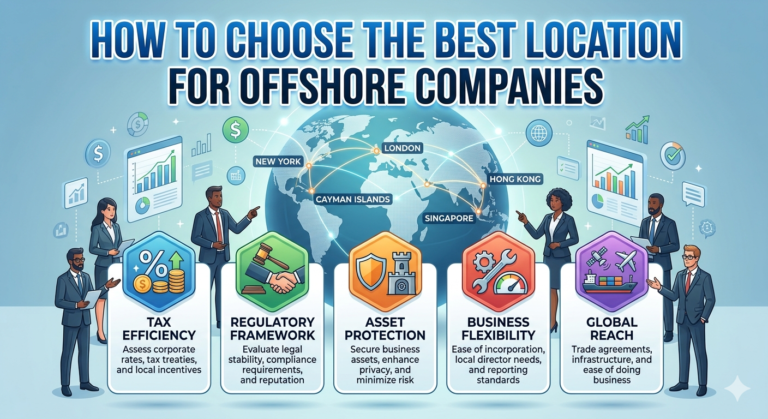
4. Choose Jurisdiction Based on Purpose, Not Just Tax Rate The cheapest jurisdiction is rarely the best one. Choose based on your actual business needs: investor familiarity, treaty networks, legal system quality, substance feasibility, and long-term regulatory stability.
5. Document Everything Thoroughly Board resolutions, minutes of meetings, management accounts, intercompany agreements, transfer pricing documentation — all of these are essential to demonstrate that your structure is real, purposeful, and compliant.
6. Review Your Structure Regularly Tax laws, bilateral treaties, and OECD rules change constantly. A structure that was optimal five years ago may be inefficient or non-compliant today. Annual reviews with your advisors are not optional — they are essential.
7. Never Conflate Structuring with Evasion Optimizing your tax position through legal structures is entirely legitimate. Concealing income, falsifying records, or failing to disclose offshore assets is tax evasion — a criminal offense. The line is clear. Stay on the right side of it.
Part 8: Common Mistakes to Avoid
Even sophisticated businesses make these errors:
- Incorporating in a jurisdiction purely for secrecy, without any substance or business purpose
- Ignoring CRS and FATCA reporting obligations, assuming offshore means invisible
- Using outdated structures that no longer comply with post-BEPS substance rules
- Failing to align the structure with actual business activity — the structure must mirror commercial reality
- Not keeping proper records — boards that never meet, decisions never documented, accounts never prepared
- Over-engineering the structure — complexity without purpose increases cost and compliance risk
- Assuming offshore means untaxed in the home country — controlled foreign corporation (CFC) rules in many countries tax offshore income at home anyway
Conclusion: Structure Smart, Comply Always
Offshore structuring remains one of the most powerful legal tools available to globally minded entrepreneurs, investors, and business owners. Used correctly — with genuine substance, full compliance, and sound professional advice — it can meaningfully reduce tax burdens, protect assets, simplify cross-border operations, and open doors to global capital.
But the rules have changed. The world is more transparent than ever. Automatic information exchange, beneficial ownership registers, economic substance requirements, and the global minimum tax have fundamentally reshaped what is possible and what is permissible.
The smartest offshore structures today are not the most secretive — they are the most purposeful, transparent, and robustly compliant.
Build your structure on that foundation, and it will serve your business well for decades.
Have questions about offshore structuring for your business or investment portfolio? Always seek advice from qualified legal and tax professionals who specialize in international structuring.